Outsourcing software development has moved from a cost-cutting tactic to a mainstream strategy for technology teams that want to move faster, access specialized skills, and scale without the overhead of full-time hiring. Whether you’re a startup validating a product or an established company expanding your engineering capacity, understanding the concrete benefits of outsourcing helps you make the decision with clarity.
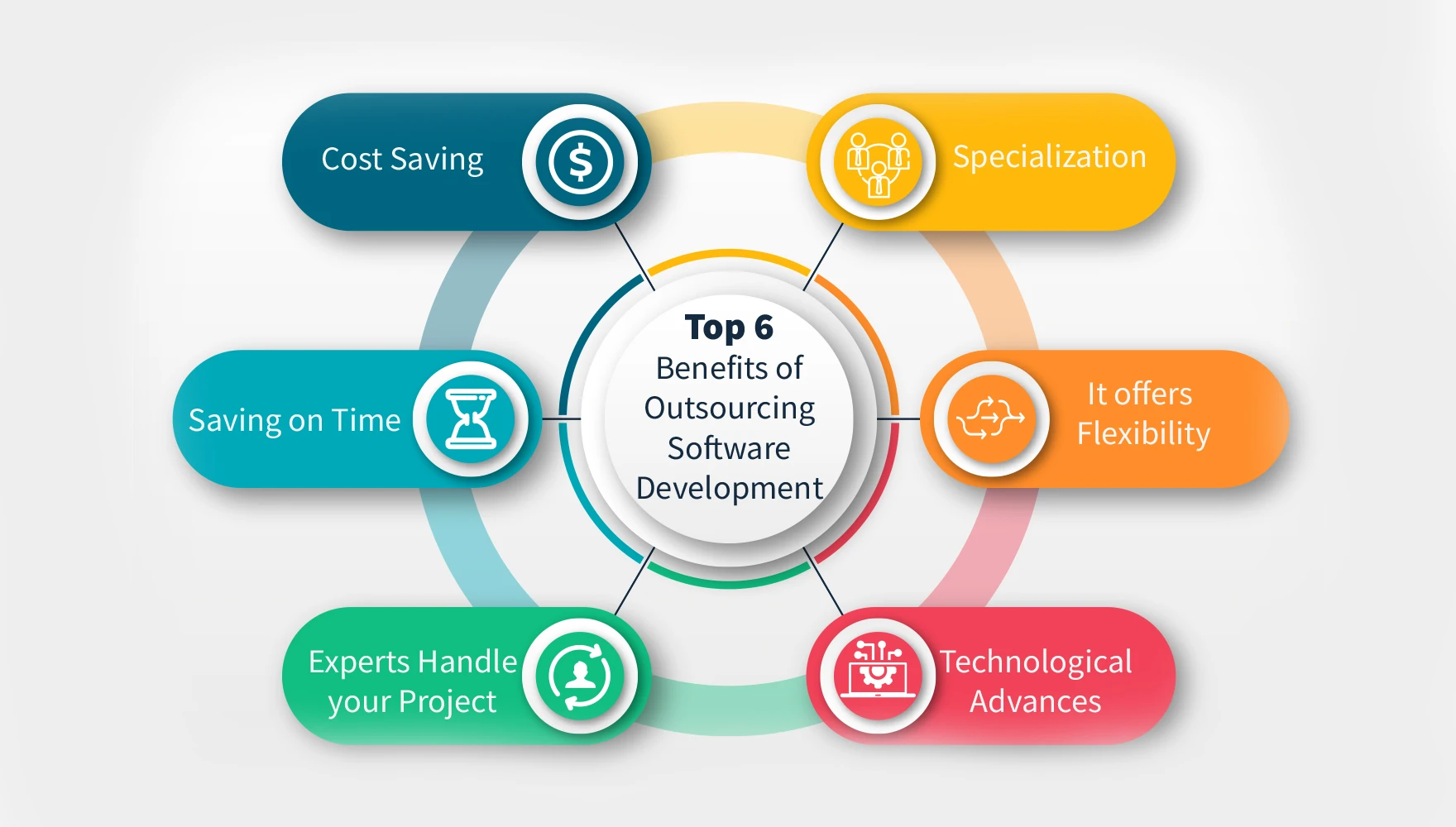
Here are the six benefits that matter most — and what they actually mean in practice.
1. Significant Cost Reduction
The most cited benefit of outsourcing is cost, and it’s real — but the full picture is more nuanced than “cheaper developers.”
When you hire full-time, the sticker price is the salary. The fully-loaded cost includes employer payroll taxes, benefits, equipment, office space, onboarding time, and recruiting fees (typically 15–25% of annual salary for a technical hire). In total, a senior engineer in the US or Western Europe costs $180,000–$250,000+ per year all-in.
Outsourcing to a quality provider in a region with competitive engineering talent — Eastern Europe, Latin America, Southeast Asia — can reduce that cost by 40–60% while maintaining senior-level quality, because the provider handles all employer overhead and operates in a lower cost-of-living context.
The savings are real. But cost alone should never be the primary driver — the quality of the output is what ultimately determines the ROI.
2. Faster Time to Market
Recruiting and onboarding a full-time engineer takes 3–5 months on average from job post to productive contributor: recruiting (4–8 weeks), notice period at their current job (2–4 weeks), onboarding and ramp-up (4–8 weeks). That’s an entire quarter before your new hire ships a meaningful feature.
Outsourcing accelerates every step. A reputable provider has pre-vetted engineers available now — not in four months. Onboarding is faster because experienced remote engineers know how to integrate into a new team. Time-to-first-contribution is measured in days, not months.
For companies under competitive pressure, this speed advantage compounds. Shipping a feature quarter earlier means a quarter more of usage data, customer feedback, and revenue.
3. Access to Specialized Expertise
Your in-house team has a particular skill set, shaped by the technology decisions you’ve made over time. When a project requires skills outside that set — a machine learning integration, a mobile app built in Flutter, a blockchain component, a specific cloud infrastructure migration — you have two options: train your team or hire someone who already knows.
Training takes time. Hiring takes time. Outsourcing to a specialist takes days.
Software development outsourcing gives you on-demand access to engineers who specialize in the exact skill your project requires. You’re not building a generalist who will eventually learn ML — you’re working with someone who has shipped ML systems in production before.
4. Focus on Core Business Activities
Engineering leadership time is finite. Every hour spent recruiting, onboarding, managing performance, and resolving HR issues is an hour not spent on architecture decisions, product thinking, and building what customers want.
When you outsource, the provider absorbs the employment overhead. Your engineering managers interact with capable engineers who are already onboarded and productive — not with the logistics of making someone productive. This frees leadership to focus on the work that actually moves the product forward.
This is particularly valuable for founders and CTOs at early-stage companies who are simultaneously building product, managing the team, talking to customers, and fundraising. Outsourcing removes an entire category of overhead.
5. Flexibility to Scale Up or Down
Building a full-time team creates a fixed cost base. When a project surge ends — after a product launch, after a major feature ships, after a growth phase levels off — you have people whose roles have changed but whose salaries haven’t.
Outsourcing converts that fixed cost into a variable one. Scale up with additional engineers when you need them, scale down with a standard notice period (typically 30 days) when you don’t. No restructuring, no severance negotiations, no organizational disruption.
This flexibility is particularly valuable during:
- Product launches requiring a temporary surge in engineering capacity
- Early-stage companies where the scope of the engineering challenge is still evolving
- Companies managing seasonal or cyclical demand patterns in their software roadmap
6. Access to Current Technology
Technology stacks evolve constantly. A team built around a particular stack in 2019 may find itself needing to integrate new AI tooling, migrate to a cloud-native architecture, or build for a mobile platform that didn’t exist when the current team was hired.
Outsourcing makes it straightforward to bring in engineers who specialize in exactly the current technology you need, rather than retraining existing staff or waiting for your team to develop new skills through a slow learning curve.
Choosing the Right Model
It’s worth noting that “outsourcing” covers a range of models — from project outsourcing (where you hand off a defined scope to an external team) to team extension and outstaffing, also known as staff augmentation, where external engineers integrate directly into your team. The benefits above apply across both models, but the degree to which you retain control, visibility, and flexibility varies significantly between them.
If maintaining control over product direction and engineering quality is important to your situation, team extension gives you the benefits of outsourcing while keeping you in the driver’s seat. If you have a well-defined project and want to delegate delivery entirely, project outsourcing handles that cleanly.
Either way, the first step is partnering with a provider who prioritizes engineering quality — because the benefits of outsourcing only materialize when the engineers doing the work are genuinely good at it.